
Drag Formula
The drag equation says air resistance grows with the square of speed: F = ½ρv²C_dA. This calculator applies it both ways — find the drag force and power for a speed, or solve for the speed, drag coefficient or frontal area — with presets for balls, cyclists and cars, air density from altitude and temperature, and a terminal velocity mode for falling objects.
- Free to use
- No sign-up
- Runs in your browser
Drag equation calculator
Drag and Motion Worksheets
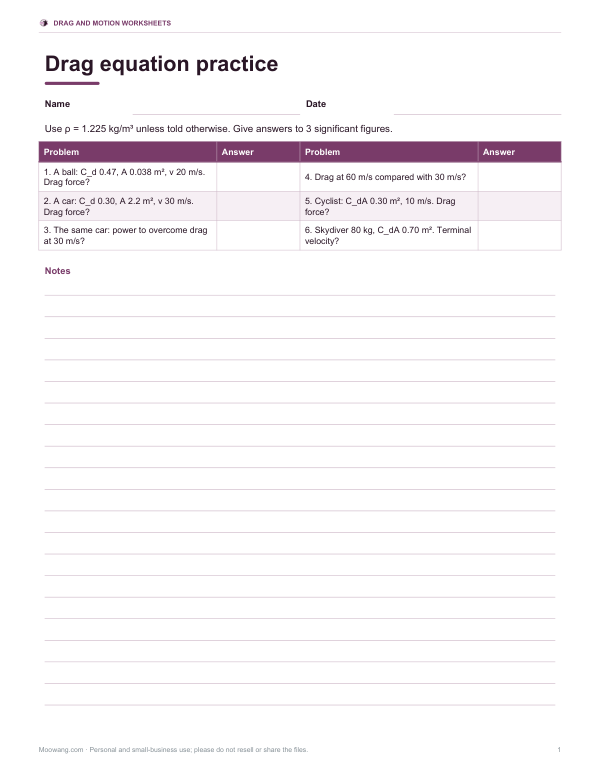
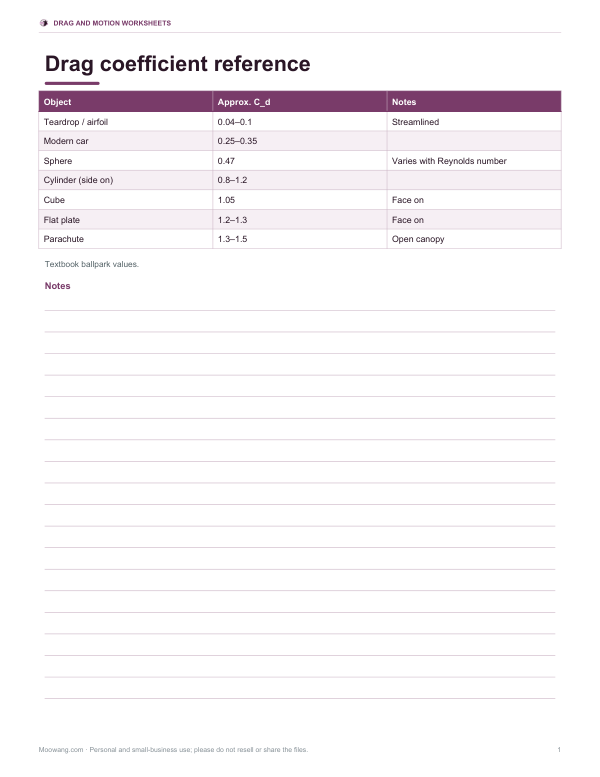
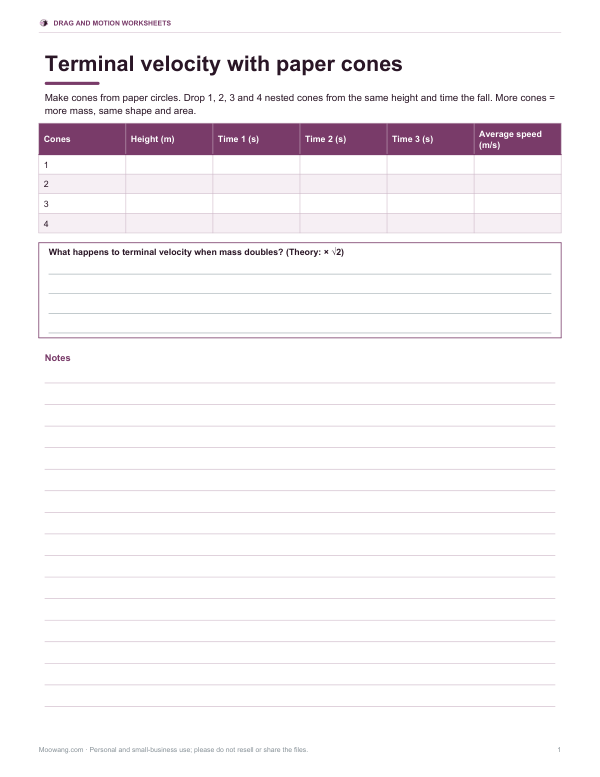
Printable drag equation and terminal velocity worksheet with worked answers, a drag coefficient reference sheet and a paper-cone terminal velocity experiment sheet.
- Drag practice (PDF, DOCX)
- C_d reference (PDF/XLSX)
- Paper-cone experiment (PDF/DOCX)
Formats: PDF, DOCX, XLSX. Instant download after payment (link valid 72 hours, up to 5 downloads). AI-assisted: the templates were drafted with AI help and reviewed and laid out before publishing.
$5.00 USD, one-time 3 files · about $1.67 each
- Instant download
- 7-day refund
- Secure checkout by Stripe
7-day money-back guarantee. Full refund within 7 days of purchase, even after you download.
Full refund within 7 days — see the refund policy and license.
Free printables
Single sheets you can print right now, no sign-up. The full pack adds every sheet in one download plus the editable files.
The drag equation
| Symbol | Meaning | Units |
|---|---|---|
| F_d | Drag force | newtons (N) |
| ρ (rho) | Density of the fluid — about 1.225 kg/m³ for air at sea level and 15 °C; about 1,000 kg/m³ for water | kg/m³ |
| v | Speed relative to the fluid | m/s |
| C_d | Drag coefficient — depends on shape | no units |
| A | Reference area, usually the frontal area | m² |
F_d = ½ × ρ × v² × C_d × A. Because speed is squared, doubling speed makes drag four times larger — and since power is force × speed, the power needed to push through the air rises eight times. That is why top speeds are so hard to increase.
Typical drag coefficients
| Object | Approximate C_d |
|---|---|
| Streamlined body (teardrop) | 0.04–0.1 |
| Modern car | 0.25–0.35 |
| Sphere (e.g. a ball, typical speeds) | about 0.47 |
| Cyclist, racing position | about 0.7 (drag area C_dA ≈ 0.25–0.35 m²) |
| Cyclist, upright | about 0.9–1.0 |
| Cube, face on | about 1.05 |
| Flat plate, face on | about 1.2–1.3 |
| Skydiver, belly-down | about 1.0 |
These are textbook ballpark values. Real coefficients vary with speed (through the Reynolds number), surface texture and exact shape, so measured values for a specific object are always better.
Worked example: a cyclist at 30 km/h
An upright cyclist with C_d = 0.9 and frontal area 0.5 m² riding at 30 km/h (8.33 m/s) in sea-level air (ρ ≈ 1.225 kg/m³) feels a drag force of ½ × 1.225 × 8.33² × 0.9 × 0.5 ≈ 19.1 N. The power to overcome it is 19.1 × 8.33 ≈ 160 W. At 40 km/h the drag rises to about 34 N and the power to about 378 W — which is why riders tuck down into the drops, reducing C_dA, when they go fast.
Air density, altitude and temperature
Thinner air means less drag. The calculator estimates air density from altitude using the standard atmosphere pressure model and your air temperature using the ideal gas law. At 2,000 m, air is about 20% less dense than at sea level, which is one reason cycling hour records and some sprint times are set at altitude. Humidity has only a small effect (humid air is very slightly less dense), so it is ignored here.
Terminal velocity
A falling object speeds up until drag equals its weight. Setting ½ρv²C_dA = mg and solving gives v_t = √(2mg / (ρC_dA)). A belly-down skydiver of 80 kg with a drag area C_dA of about 0.45 m² reaches roughly 190 km/h in sea-level air; in a head-down position with a much smaller area, speeds are far higher. The rough time estimate assumes drag builds as speed rises and is only a guide.
Using the calculator
- Choose what to solve for.
- Pick a preset or enter your own drag coefficient and frontal area.
- Enter speed in km/h (or force for the reverse modes).
- Set altitude and temperature to adjust air density.
- Read the force, power, speed, coefficient or terminal velocity.
Reducing drag in practice
- Reduce frontal area — a cyclist tucking down, a car with a lower roof line.
- Improve shape — rounded fronts and tapered tails keep airflow attached and shrink the wake.
- Smooth or tuned surfaces — skinsuits, wheel covers and, counter-intuitively, dimples on golf balls, which reduce drag at the right speeds.
- Drafting — riding or driving behind another object in its wake can cut drag substantially.
- Remove add-ons — roof boxes and open windows add noticeable drag at motorway speeds.
Drag in water
Water is about 800 times denser than air, so the same shape at the same speed feels about 800 times the drag. The calculator is set up for air; for fresh water, multiply its sea-level result by about 816 (1,000 ÷ 1.225); swimmers and boats are dominated by drag and wave-making resistance, which is why speeds in water are so much lower.
When the equation does not apply well
- Very slow, tiny objects (dust, droplets) where viscous (Stokes) drag dominates.
- Near or above the speed of sound, where compressibility changes drag dramatically.
- Objects that change shape or posture, like a cyclist standing up.
- Wind: use the speed relative to the air, not to the ground.
Physics printables
The optional pack includes a drag and terminal velocity worksheet with worked answers, a coefficients reference sheet and an experiment sheet for measuring terminal velocity with paper cones. The calculator above is free.
AI-assisted content
This page was drafted with AI assistance and reviewed before publishing.
Frequently asked questions
What is the drag formula?
F = ½ρv²C_dA.
What is the drag coefficient of a sphere?
About 0.47 in typical conditions.
How does speed affect drag?
Drag rises with the square of speed; power with the cube.
What is the density of air?
About 1.225 kg/m³ at sea level and 15 °C.
How do you calculate terminal velocity?
v_t = √(2mg / (ρC_dA)).
Does altitude reduce drag?
Yes, thinner air reduces drag in proportion to density.
What is drag area?
The product C_d × A, which captures both shape and size; cyclists often quote it directly.
Why do cyclists ride in groups?
Riders behind others sit in their wake and face much less drag, saving energy.
Does a heavier object fall faster?
With the same shape and size, yes — its terminal velocity is higher because weight rises while drag stays the same.